AI is changing how skin can be assessed from images. An AI Skin Analysis Technology system uses cameras, image processing, and trained machine-learning models to identify visible skin features. An AI Face Scanner can assess areas such as spots, redness, wrinkles, pores, and texture, depending on the system.
Facial Skin Analysis can then turn these observations into measurements or risk scores. The technology is also being studied in dermatology, where AI can support the assessment of skin conditions and lesions. In 2026, a Scientific Reports study used AI to analyse facial skin phenotypes in 500,386 Chinese men, one of the largest datasets of its kind. In this article, we will explain how AI skin analysis works, what technology powers it, what it can measure, and where its current limits lie.
What Is AI Skin Analysis?
AI skin analysis is the use of computer vision and machine learning to assess images of the skin. The basic idea is simple. You provide an image. The software processes it. A trained model looks for visual patterns linked to specific skin features.
Depending on the system, it may estimate:
- Fine lines and wrinkles
- Pigmentation and dark spots
- Redness
- Acne or visible blemishes
- Pore appearance
- Skin texture
- Oiliness or dryness indicators
- Uneven skin tone
- Some types of skin lesions
The exact results depend on the camera, lighting, image quality, training data, and purpose of the model. A cosmetic skin-analysis tool and a medical diagnostic system should not be treated as the same type of technology.
How Does the Technology Work?
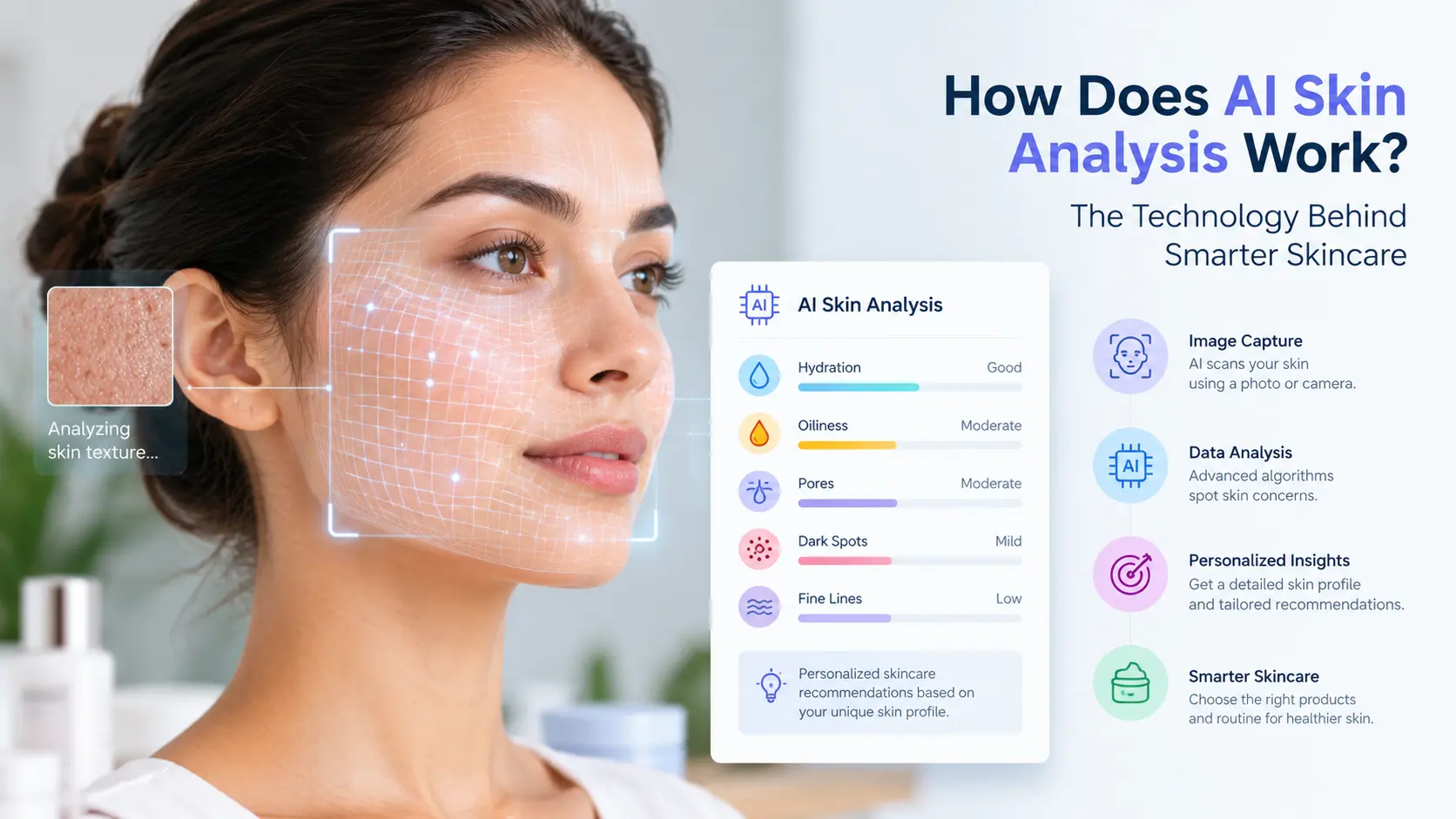
An AI skin scan usually follows several technical steps.
1. The camera captures the skin
The process starts with an image. This may come from a smartphone camera, a clinic imaging system, a dermatoscope, or another specialised device.
Good image quality matters. Shadows, reflections, makeup, camera distance, and exposure can change what the software sees. Some professional systems use controlled lighting and fixed camera positions. This helps make results more consistent.
2. The software prepares the image
The system first processes the image. It may identify the face and separate the skin from areas such as hair, eyes, lips, and clothing. It can also correct or standardise factors such as image size and lighting. This step gives the model a cleaner input.
3. Computer vision identifies patterns
The AI then examines pixels and visual patterns. Modern systems often use deep-learning models, including convolutional neural networks. These models can learn features from large collections of labelled images.
For example, a model trained to recognise pigmentation learns visual patterns associated with pigmentation in its training data. It does not "understand" skin in the same way a dermatologist does. The model calculates the likelihood that certain patterns are present.
4. The model produces measurements or predictions
The output depends on what the system was designed to do. A consumer tool may produce a score or estimate for visible concerns. A clinical model may classify a lesion or help assess disease severity.
Research shows that AI can perform well on specific dermatology tasks. A 2026 systematic review in JAMA Dermatologyanalysed 11 prospective studies involving more than 2,500 participants. For melanoma detection, pooled sensitivity was 80.9% for AI and 78.6% for dermatologists, while pooled specificity was 75.6% for AI and 75.2% for dermatologists. The researchers also stressed that many studies had important risks of bias and that larger real-world studies are still needed.
5. Results are presented to the user
The final step turns the model's output into something you can read. You may see a list of detected concerns, numerical scores, images showing affected areas, or changes over time.
That makes AI useful for tracking visible changes. But a score is not automatically a medical diagnosis.
What Data Does AI Learn From?
AI models depend heavily on their training data. Developers may train models using thousands or millions of images. These images can include clinical photographs, dermoscopic images, or standard facial photographs. Some datasets also contain information about age, sex, skin characteristics, diagnoses, or other clinical factors.
The quality of this data affects the model. A model trained mostly on one population may not work equally well for another. Skin tone and the type of condition being assessed can all affect performance.
A 2024 review of AI and total-body photography noted that many research models were developed in controlled settings and did not fully represent real clinical practice, where skin phenotype and a person's clinical background also matter.
This is why claims about accuracy should always be tied to the specific model and testing method.
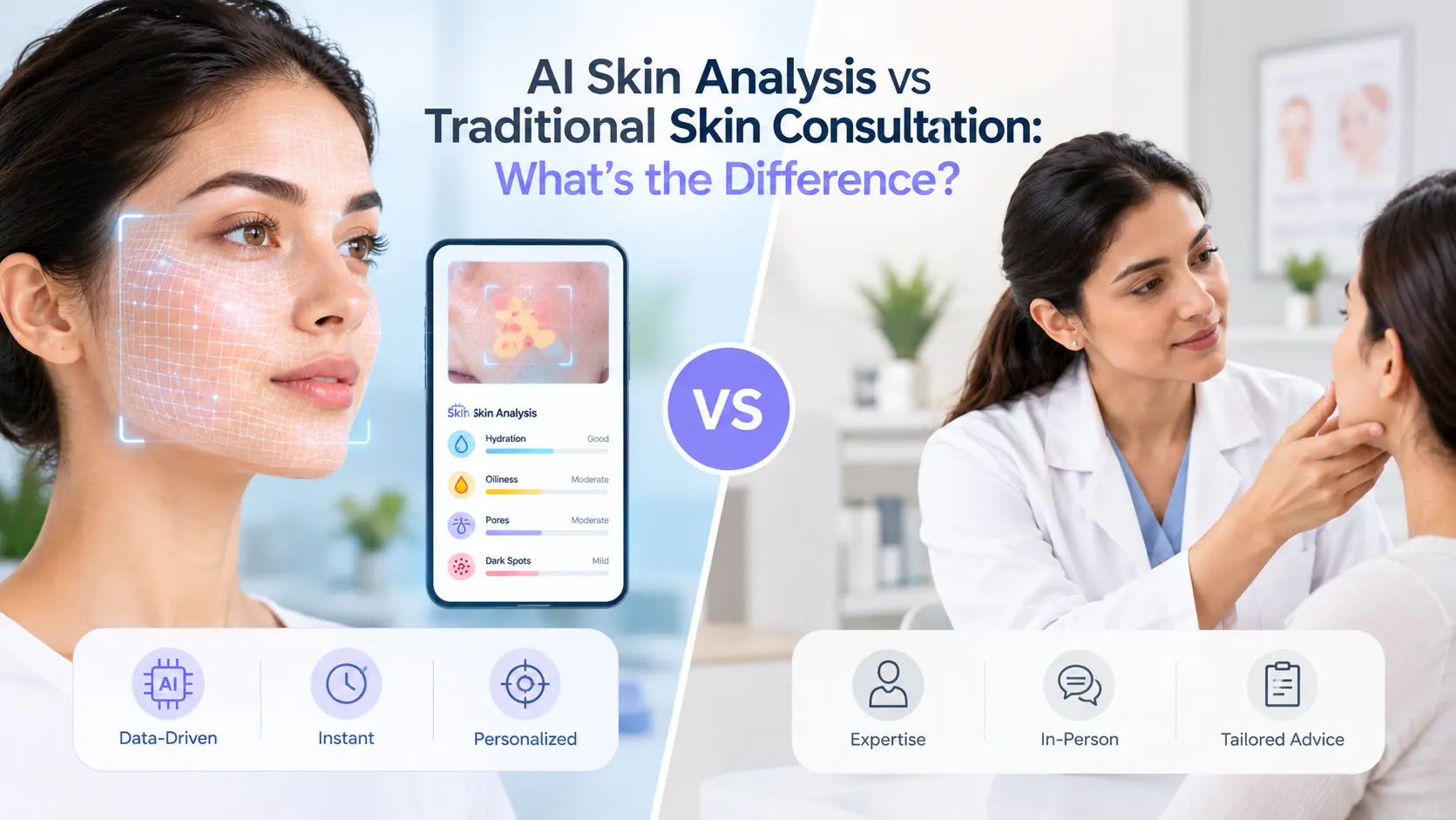
AI Skin Analysis vs. Dermatologist Assessment
AI can process images quickly and apply the same trained rules to each image. A dermatologist brings clinical judgement and information that may not appear in a photograph.
A doctor can consider:
- Your symptoms
- How long the problem has been present
- Medicines you use
- Previous skin problems
- Family history
- Physical examination findings
- Changes over time
- Information from dermoscopy or other tests
AI may therefore work best as an assessment aid rather than a replacement for medical care.
The FDA also classifies certain AI-enabled dermatology devices as adjunctive tools. Its classification for software that assesses suspicious skin lesions states that such systems are intended to support a physician and are not standalone diagnostic tools.
What Can Affect an AI Skin Scan?
|
Factor
|
Why it matters
|
|
Lighting
|
Shadows and strong reflections can change visible colour and texture
|
|
Camera quality
|
Low resolution can hide small features
|
|
Skin tone
|
Models may perform differently across skin tones if training data is limited
|
|
Makeup
|
Cosmetics can hide redness, pigmentation, or texture
|
|
Camera distance
|
Different distances can affect measurements
|
|
Image angle
|
Side lighting or tilted images can change the appearance of features
|
|
Training data
|
Limited or unbalanced datasets can reduce generalisability
|
|
Model purpose
|
A cosmetic scoring model is not equivalent to a medical diagnostic model
|
For this reason, PERS ACTIVE LAB should be viewed in the wider context of evidence-based skin assessment rather than treating an AI score as a clinical finding.
Can AI Skin Analysis Diagnose Skin Conditions?
Sometimes AI is specifically developed for medical diagnosis, but that does not mean every skin-analysis app can diagnose disease.
Research has shown strong results for selected dermatology tasks. A 2025 systematic review found pooled melanoma sensitivity of 86% and specificity of 94% across the included AI studies. However, the authors also found substantial concerns about study bias and the representativeness of datasets.
Another 2025 meta-analysis found that AI models assessed inflammatory skin-disease severity correctly about 81% of the time on average, with performance varying by disease and scoring system.
The practical point is simple: accuracy is task-specific. A model that estimates pigmentation from a facial photograph cannot automatically diagnose melanoma, eczema, or another medical condition.
Why Image Quality and Skin Tone Matter
AI does not examine skin in a vacuum. It examines the information contained in the image. This creates an important issue with representation. Facial Skin Analysis can be affected by image quality, lighting, and differences in skin tone. A 2026 Nature Medicine study involving 623 lay participants and 153 primary-care physicians found that a fairness-constrained dermatology AI model with balanced performance across skin tones reduced skin-tone-related performance differences. The study also found that people could be more affected by incorrect AI suggestions than trained physicians.
This supports a key principle: better AI does not only mean better algorithms. It also requires diverse data, careful testing, and sensible human oversight.
How AI Can Help With Skincare Tracking
For non-medical skincare, AI can be useful for consistency.
You can take images under similar conditions and compare visible changes over time. This may help you notice changes in pigmentation, redness, texture, or other measurable features.
However, changes in hydration, lighting, facial expression, or camera settings can affect the result. A higher or lower score does not always mean your skin has biologically improved or worsened.
PERS ACTIVE LAB can therefore be discussed as part of a broader approach where digital measurements support observation, rather than replace professional assessment when a medical concern is present.
What Are the Main Limits?
AI skin analysis has several clear limits. First, an image cannot capture every aspect of skin health. Some symptoms cannot be seen clearly in a photograph.
Second, different systems use different datasets and scoring methods. Two tools can therefore produce different results from the same image.
Third, research performance does not always equal real-world performance. A 2026 review of AI in dermatology highlighted concerns about small datasets, limited diagnostic diversity, selection bias, and inconsistent evaluation methods.
Finally, AI can create false confidence. A reassuring result should not stop you from seeing a dermatologist when a lesion changes, bleeds, grows, hurts, or otherwise concerns you.
Conclusion
AI Skin Analysis Technology works by combining image capture, computer vision, and machine-learning models to measure or classify visible skin features. An AI Face Scanner can provide useful information about measurable changes, while Face Skin Analysis can help organise those observations.
The technology is developing quickly, and 2026 research shows promising results in several dermatology applications. Still, accuracy depends on the task and the data behind the model. AI should support informed skincare decisions, not create false certainty. For PERS ACTIVE LAB, that means treating digital skin analysis as a useful source of information while keeping professional dermatology assessment at the centre when a medical concern appears.
Frequently Asked Questions
1. Is AI skin analysis accurate?
It can be accurate for specific tasks. But, there is no single accuracy rate for all AI skin-analysis tools. Performance depends on the model, condition, image type, population, and testing method. Clinical research shows promising results, but real-world validation remains important.
2. Can I use an AI skin scan instead of seeing a dermatologist?
No. A consumer scan should not replace a medical assessment. Some AI systems are designed specifically as clinical decision-support tools. But, even those may be intended to assist a healthcare professional rather than provide a standalone diagnosis.
3. Does AI skin analysis work for all skin tones?
Not necessarily. Performance can vary when training data does not adequately represent different skin tones. Recent research shows that models designed with balanced performance across skin tones can reduce these differences, but this remains an important area of AI development.
4. What should I do before taking an AI skin-analysis photo?
Use clean skin when the system requires it, follow the tool's camera instructions, use even lighting, keep the camera at the recommended distance, and avoid changing lighting between scans when you are tracking progress. Consistent images make comparisons more useful.

 Member Center




 Successfully Added!