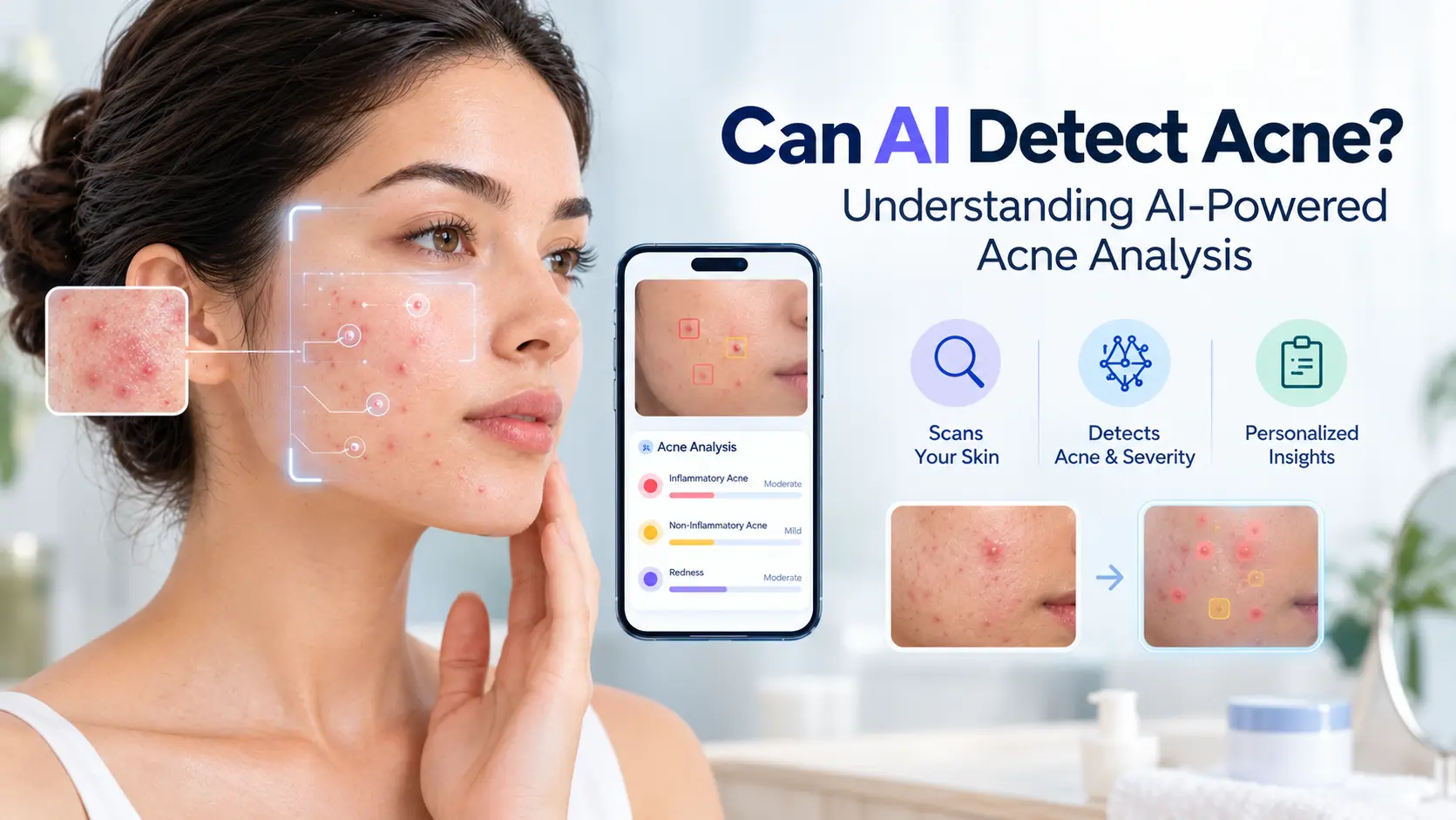
If you've ever taken a selfie inside a skincare app and watched little boxes pop up around your breakouts, you've already used AI acne detection without necessarily knowing the name for it. The question people usually ask next is whether the technology is actually reading their skin correctly, or just guessing well. The short answer is that it depends on the system, the image quality, and what you're asking it to do. Here's what's actually happening behind that scan, and where it holds up.
Acne turned out to be a natural next application, since it involves the same basic task: finding a pattern in a photo and putting a label on it. The difference is scale. Skin cancer screening usually happens in a clinical setting with a trained camera and a controlled environment. Acne scans mostly happen on a phone, in a bathroom, under whatever light happens to be on.
What Is AI Acne Detection?
This is the use of computer vision and machine learning to identify acne lesions in a photo of your face, then classify what type they are. A well-built system doesn't just say "you have acne." It can point out individual comedones, papules, pustules, and nodules, count them, and use that count to generate a severity score.
This is different from a basic filter or a simple "spot the blemish" tool. Underneath, these systems are trained on thousands of labelled images so they learn to recognise the visual patterns dermatologists use when grading acne by eye. The output is essentially a structured version of what a clinician would jot down during an in-person exam, minus the years of training required to do it yourself.
Just How Accurate Is an Acne Scanner?
Accuracy is the part people are most skeptical about, and fairly so. A photo can be misleading if the lighting is off or the camera angle hides part of the face.
That said, the research behind this technology has come a long way. A 2025 study on a hybrid deep learning model, combining image segmentation with a classification network, reported a validation accuracy of 97 percent when tested against labelled acne datasets, alongside similarly high precision and recall scores. Accuracy figures for hybrid deep learning acne detection models are drawn from a 2025 peer-reviewed study published on PubMed Central. That level of performance puts a well-trained model within striking distance of expert-level grading for common, clearly visible acne types.
Where accuracy tends to slip is at the edges. Models can still struggle to tell acne apart from other conditions that look similar in photos, like rosacea, eczema, or pigmentation marks. This is why most credible tools like this are framed as a first read, not a diagnosis.
How an Acne Scanner Actually Works, Step by Step
Behind the simple "upload a photo, get a result" experience through Acne Scanner, there's a fairly consistent pipeline running underneath.
- Image capture: You take or upload a photo, usually with guidance on lighting and angle to keep the input consistent.
- Face and region mapping: The system identifies your face and breaks it into zones, like forehead, cheeks, chin, and jawline.
- Lesion detection: Computer vision scans each zone for the visual signatures of acne lesions.
- Classification: Each detected spot gets sorted into a category: comedone, papule, pustule, or nodule.
- Severity scoring: The counts and types feed into a scoring model, giving you a standardized read on how mild or severe things look right now.
- Recommendation: Many tools then match that score against a set of product or routine suggestions.
None of these steps happen in isolation. A weak result at the face-mapping stage, say, a photo taken at an angle, will throw off everything that follows, which is part of why image quality matters so much.
What AI Can and Can't Tell You About Your Skin
This kind of tool is genuinely useful for tracking change over time and giving you a consistent, repeatable read on your skin instead of relying on memory or mood. It's less useful, and sometimes unreliable, for anything that requires medical judgment. You can get good acne analysis, but verification is a must.
Here's a simple way to think about the split:
Treat the score as a data point, not a verdict. If a scan keeps flagging worsening severity, or if something looks unusual and doesn't fit the pattern, that's a reason to see a professional, not a reason to keep adjusting your own routine based on an app.
Where Acne Analysis Tools Are Already Being Used
This technology isn't experimental anymore. Skincare brands use it inside their apps to guide product recommendations. La Roche-Posay's Effaclar Spotscan, for instance, grades visible acne on a numbered scale and pairs the result with a suggested routine. Beauty tech providers have built similar scanning features into retail apps, letting a single photo flag several skin concerns at once rather than just acne on its own.
Teledermatology platforms use related models to triage patients before a video consultation, helping clinicians prioritise cases that need faster attention. Hospitals researching dermatology AI have also started validating these models directly against expert grading, comparing machine output to what an experienced dermatologist would score by eye.
The common thread across all of these uses is the same: this kind of scan works best as a fast, consistent first pass, with a human in the loop for anything that needs a real diagnosis or prescription.
Getting the Best Results from Your Scan
A scan is only as good as the photo behind it. A few habits make a measurable difference in accuracy:
- Use natural, even lighting, and avoid harsh overhead light that creates shadows.
- Keep your face straight on to the camera, not tilted or angled.
- Skip makeup or heavy skincare products right before scanning, since they can mask or mimic texture.
- Take the photo at the same time of day and distance each time, so comparisons over weeks actually mean something.
- Use the same device or camera setting if you're tracking progress, since different cameras process color and detail differently.
Small inconsistencies here are the most common reason two scans of the same skin, taken a day apart, come back with noticeably different scores.
Conclusion
None of this is magic, and it isn't a replacement for a dermatologist. What it does well is turn something subjective- how bad does my skin look right now- into a consistent, trackable number, and it does that quickly enough to actually fit into a daily routine.
At PERS ACTIVE LAB, this is exactly the problem our tool was built to solve: a fast, honest read on your skin that helps you see real progress instead of guessing at it. Try the AI Acne Detection tool and see what a data-backed look at your skin actually tells you.
FAQs
1. Can AI acne detection replace a dermatologist visit?
No. It's a useful first step for tracking and understanding visible acne, but it can't diagnose underlying causes, rule out other skin conditions, or prescribe treatment.
2. How accurate is this compared to a dermatologist's assessment?
Recent research shows well-trained models reaching accuracy above 95 percent on clear, well-lit images of common acne types. Accuracy drops when lighting is poor or when the condition resembles something other than typical acne.
3. Does this work well on all skin tones?
Not always equally well. Some earlier models were trained on limited datasets that underrepresented darker skin tones, which affected accuracy. Newer tools are being trained on more diverse image sets to close that gap, so it's worth checking how a specific tool was validated.
4. How often should I scan my skin to track progress?
Weekly is usually enough to spot real trends without over-analysing normal day-to-day fluctuation. Scanning daily can actually make it harder to see the bigger picture, since minor changes get amplified.
5. Is my photo data safe when I use a tool like this?
This depends entirely on the provider. Look for tools that are clear about encryption, data storage location, and whether your images are used to train future models without your consent.

 Member Center




 Successfully Added!